Garage floors
Epoxy garage floors that suit Durban's damp summers
A garage slab here spends a good part of the year in air that is close to saturated. The long-run records for Durban put average relative humidity at 80% from January through March. That figure matters because the garage epoxies we read up on set 80% as their ceiling for application day.
So the job starts with readings: slab moisture, air humidity and the gap between the concrete's temperature and the dew point. When those numbers are right, the coating bonds and cures clear.
Get a Free Quote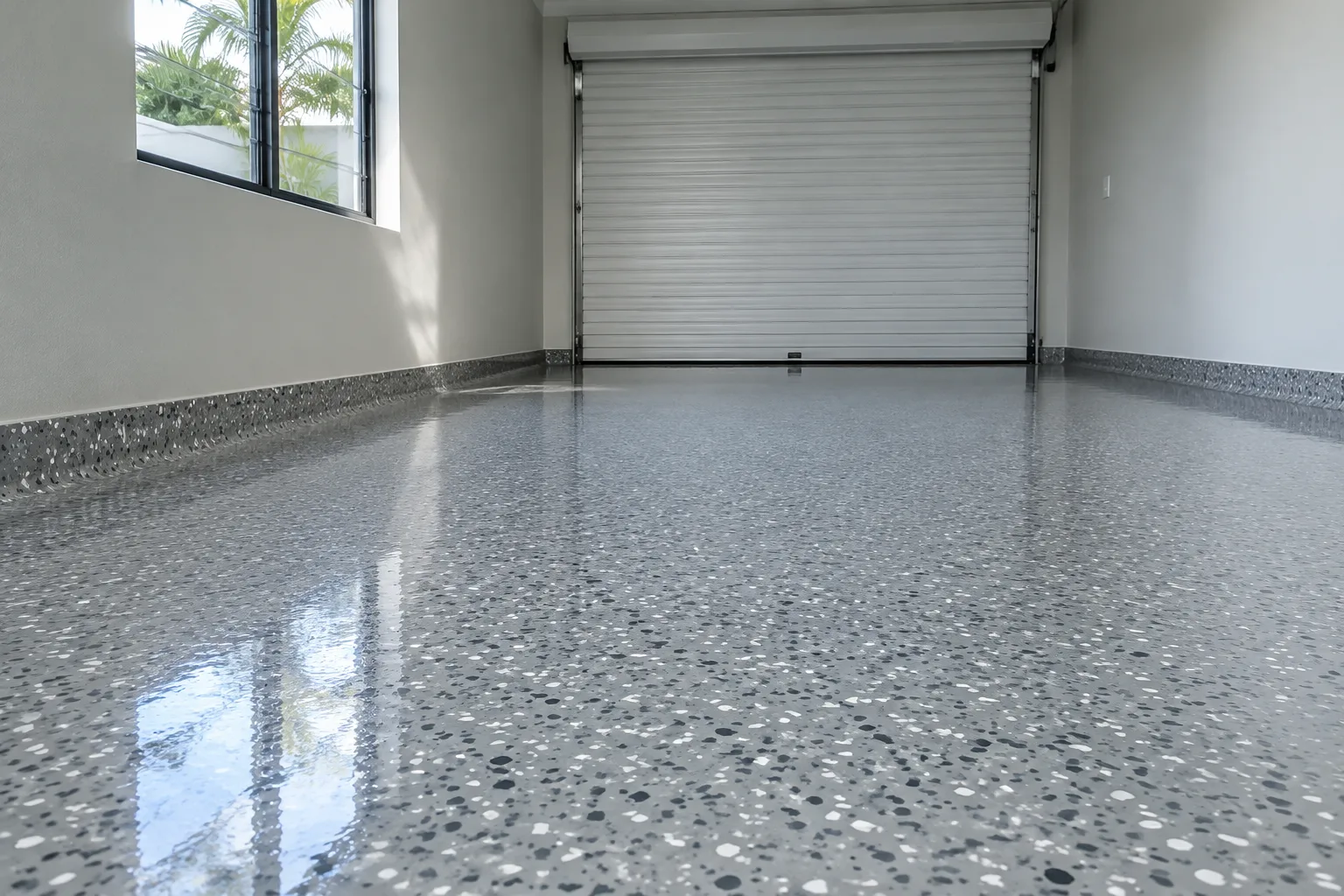
Three things we measure before coating a garage here
Water coming up through the slab
Garages built at ground level, or cut into a slope below the house, can draw moisture from the soil. We tape down a sheet of polyethylene and check for condensation under it, then take a meter reading. The figure the data sheets want is around 4% or below.
The dew point on the day
Fresh epoxy needs a slab that sits 3 °C or more above the dew point. A cool slab under warm, wet air collects a film of water you cannot see, and the coating blooms into a milky, tacky patch. We check with a hygrometer and a surface thermometer before mixing anything.
Afternoon sun on the doorway strip
Garage epoxy may shift colour slightly where direct sun lands on it. That does not weaken the floor, but it can leave the first metre inside the door a shade off from the back wall. A UV-stable seal over the top is worth discussing for west-facing doors.
Is your concrete strong enough to hold a coating?
Epoxy grips the top few millimetres of concrete and nothing deeper. Manufacturer sheets want concrete that withstands 25 N/mm² of crushing load, and a surface that resists 1.5 N/mm² when a test dolly is glued on and pulled. A dusty, crumbling surface or a skim of old screed can fall short of that. We grind with diamonds to remove the weak skin and old paint, then look at what is underneath.
Cracks get their own decision. The same data sheets warn that a crack assessed badly will reappear through the new coating. Hairline shrinkage cracks are filled and ground flush. A crack that has stepped, or one that keeps opening, points to movement in the slab, and we will tell you that rather than hide it under a fresh colour.
If your garage floor currently wears a coat of paint that is peeling where the tyres sit, our article on why floor paint lets go and two-part epoxy does not explains the difference in plain terms.
How long the car stays out
These are the curing times published for one water-based garage epoxy sold in South Africa. Warmer weather speeds things up, which is one advantage of a Durban summer. Your quote will give the times for the system we actually specify.
| Slab temperature | Walk on it | Drive a car in | Fully cured |
|---|---|---|---|
| Around 30 °C | about 10 hours | about 2 days | about 5 days |
| Around 20 °C | about 20 hours | about 3 days | about 7 days |
| Around 10 °C | about 48 hours | about 5 days | about 10 days |
Source: Sika South Africa product data sheet for Sikafloor Garage, September 2026. Times are the manufacturer's approximations and stretch in humid, still weather.
Picking a finish for a working garage
A solid colour in a semi-gloss is the plainest option and the easiest to keep clean of oil drips. If the garage doubles as a workshop or the dogs live in it, a broadcast of coloured chips hides dust and scuffs better; our flake floor page goes through chip sizes and texture. Where the floor runs out to a covered patio or a wet entrance, we add fine quartz to the top coat for grip.
The same coating can carry on through the inside door into a laundry, scullery or converted flatlet, which we cover under epoxy floors for the rest of the house.
An older single garage in Durban North and a new double garage on an estate outside Ballito get the same moisture test, because the age of a slab tells you little about what is under it. On an estate, read the contractor rules before you book a date; grinding is loud for a day.
For rand figures by floor size and finish, see the epoxy pricing guide. A site visit is still the only way to price your own slab, because grinding time depends on what is already on it.
Before you book a garage floor
Book a slab check for your garage
Tell us the size of the garage and roughly how old the house is. It costs you nothing to request a quote.
Request a garage quote