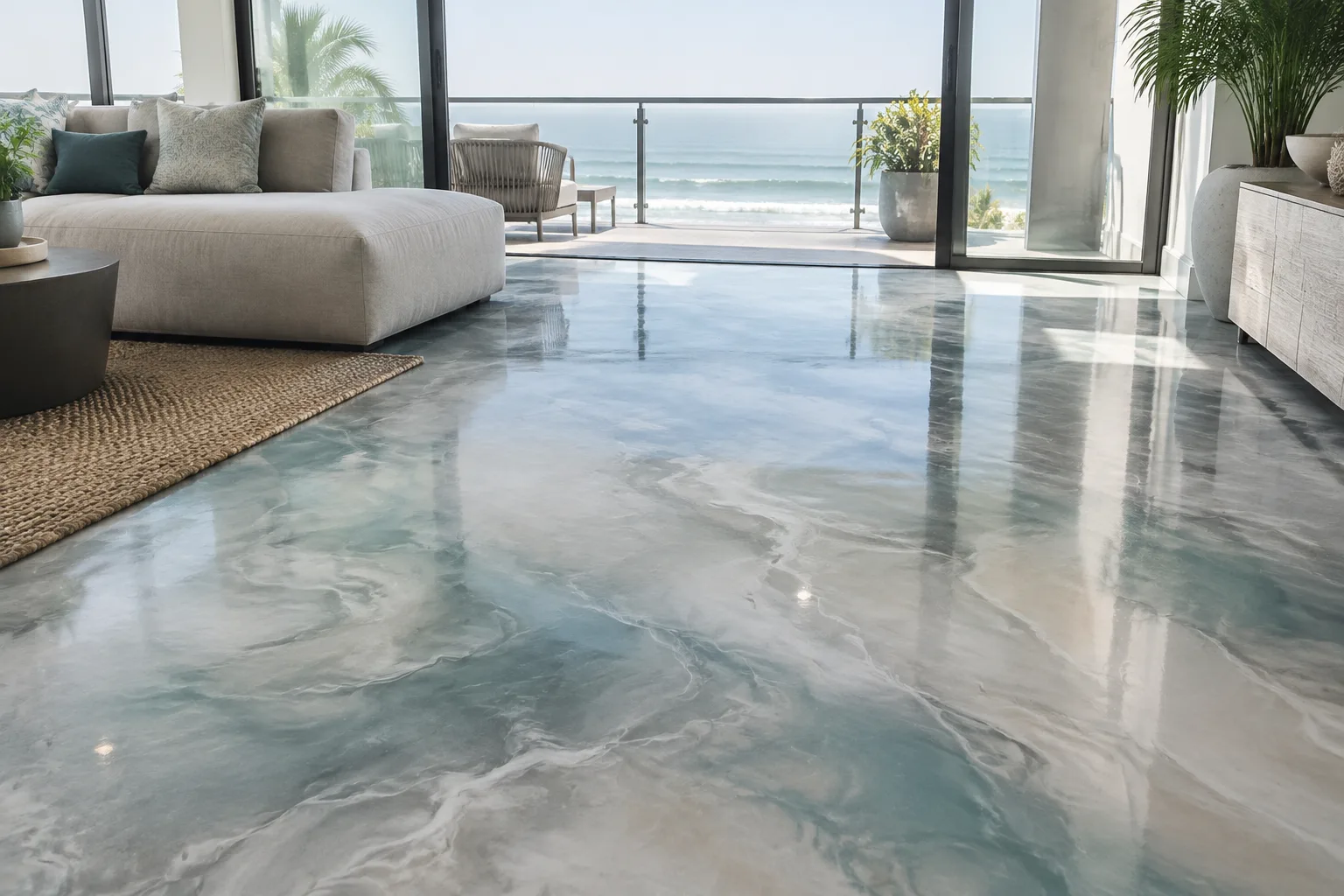
Metallic epoxy floors for bright coastal rooms
Swirled metallic resin looks its best in daylight, and Durban has plenty of it: roughly 2,365 hours of sunshine a year on the long-term record. The same light is hard on bare epoxy. We plan the topcoat around the windows before anyone opens a tin of pigment.
Get a Free QuoteWhat sun does to an unprotected epoxy
Epoxy resins and sunlight do not get along. A widely used South African floor epoxy states in its own data sheet that direct sun may cause discolouration and colour variation, and that the product is for interior use. On a plain grey workshop floor nobody notices. On a pale pearl-and-grey metallic in an open-plan room with sliding doors to the garden, a warmer band near the glass is exactly what you would see.
The fix is a separate wearing layer. Polyurethane topcoats are made that resist UV and are described by their maker as non-yellowing. They go on in two thin coats over the cured metallic layer, covering roughly 8 to 10 m² from each litre on every pass, for the one we checked, and they take the scuffing that the decorative layer underneath would otherwise suffer.
The layers, from concrete up
- 1
Ground and repaired slab
We grind with diamond tooling until the primer has open pores to soak into. Tile adhesive, old screed and paint come off first. A metallic coat shows every dip, so low spots are filled.
- 2
Primer and a solid base colour
The base sets the depth of the finish. A dark base under silver reads as stormy water; a white base under pearl reads as polished shell.
- 3
The metallic pour
Clear resin carrying metallic pigment is poured and worked by hand while it is still fluid. This is the step you are paying for, and it is done in one session per room so there are no joins.
- 4
UV-resistant polyurethane topcoat
Two coats, applied inside the recoat window. For the product we checked, that window at about 20 °C opens after 12 hours and closes at 24.
Why the pour date can move
A metallic floor cannot be patched afterwards, so the pour happens only when the room is inside the resin's limits. The floor epoxies we read up on allow no more than 80% relative humidity, and Durban averages 80% from January to March. Air conditioning running the day before helps. A sticky February with the windows open usually does not.
We specify a single production batch for all the resin going into one room. Manufacturers advise this for exact colour matching, and with metallic pigment a small shift between batches shows up as a seam.
Metallic is one option within our home flooring work; for a garage, a solid or chip-broadcast finish copes better with grit and tyres.
Rooms where metallic earns its keep
Living areas with the furniture kept light, home offices, boutique shops, salons and showrooms all suit it. Apartments facing the sea in Umhlanga and the newer homes around Ballito tend to have big glazed openings, which is where the topcoat decision matters most. Sectional title owners will need trustee approval for some work; we explain what to ask for on the residential page.
Metallic costs more than a solid colour because of the extra layer and the hand work. The price guide shows how the finishes compare.
Metallic floor questions
Start with the room and its light
Tell us the floor area, and send a daylight photo if you have one. Requesting a quote is free.
Ask for a metallic quote