
Durban's airport records 15 or more rainy days a month from October through January, and 16 in November. Every one of those days a car can roll into the garage on wet tyres. That single habit decides more Durban floor jobs than colour or budget, because one of the two products sold as "epoxy floor paint" is written off for exactly that use by its own maker.
The short answer
- One coat of a single-pack floor paint dries to 25 to 35 microns, according to the UK data sheet we checked. A solvent-free epoxy roller coat on a South African data sheet works out at roughly 0.28 to 0.50 mm, which is 8 to 20 times as much film per coat.
- That paint sheet excludes garages where wet tyres stand for long periods, and slabs without an effective damp-proof membrane.
- Epoxy asks more on the day it goes down: slab moisture of 4% or less, air humidity of 80% or less and a slab at least 3 °C above dew point.
- Paint is a fair choice for a dry room with foot traffic only.
Three products that all get called "epoxy floor paint"
The phrase covers more than one chemistry. The way to sort them is the technical data sheet, which every manufacturer publishes for its coatings. We took one of each type and lined up what their sheets say about the film you are left with once the coating has dried.
| Type | Data sheet we read | Solids by volume | Dry film per coat | Working time once mixed |
|---|---|---|---|---|
| Single-pack alkyd floor paint | Dulux Trade Floorshield (UK, issued 2014) | 53% | 25-35 µm | No mixing, single pack |
| Water-based two-part epoxy | Sikafloor Garage (South Africa, 2026) | 45% | about 70-105 µm* | about 60 min at 20 °C |
| Solvent-free two-part epoxy, roller coat | Sikafloor-264 ZA (South Africa, 2026) | about 100% | about 280-500 µm* | about 25 min at 20 °C |
*Our arithmetic from each sheet's coverage rate, mixed density and solids content. Neither Sika sheet prints a film thickness for these coats directly.
Solids matter because everything else evaporates. The alkyd paint carries white spirit, so close to half of what you roll on leaves the room as vapour. The water-based epoxy loses more than half its volume as water. The solvent-free epoxy keeps nearly all of it, so the wet coat and the dry coat are about the same thickness.
Dry film left by one coat
- Single-pack alkyd floor paint25-35 µm
- Water-based two-part epoxyabout 70-105 µm
- Solvent-free epoxy, roller coatabout 280-500 µm
Floorshield's figure is printed on its sheet. Both Sika figures are our arithmetic from coverage, density and solids.
When the same resin is filled with sand and poured as a self-smoothing layer, the sheet stops talking in grams per square metre and starts quoting kilograms per square metre for every millimetre of floor.
Wet tyres are the Durban test
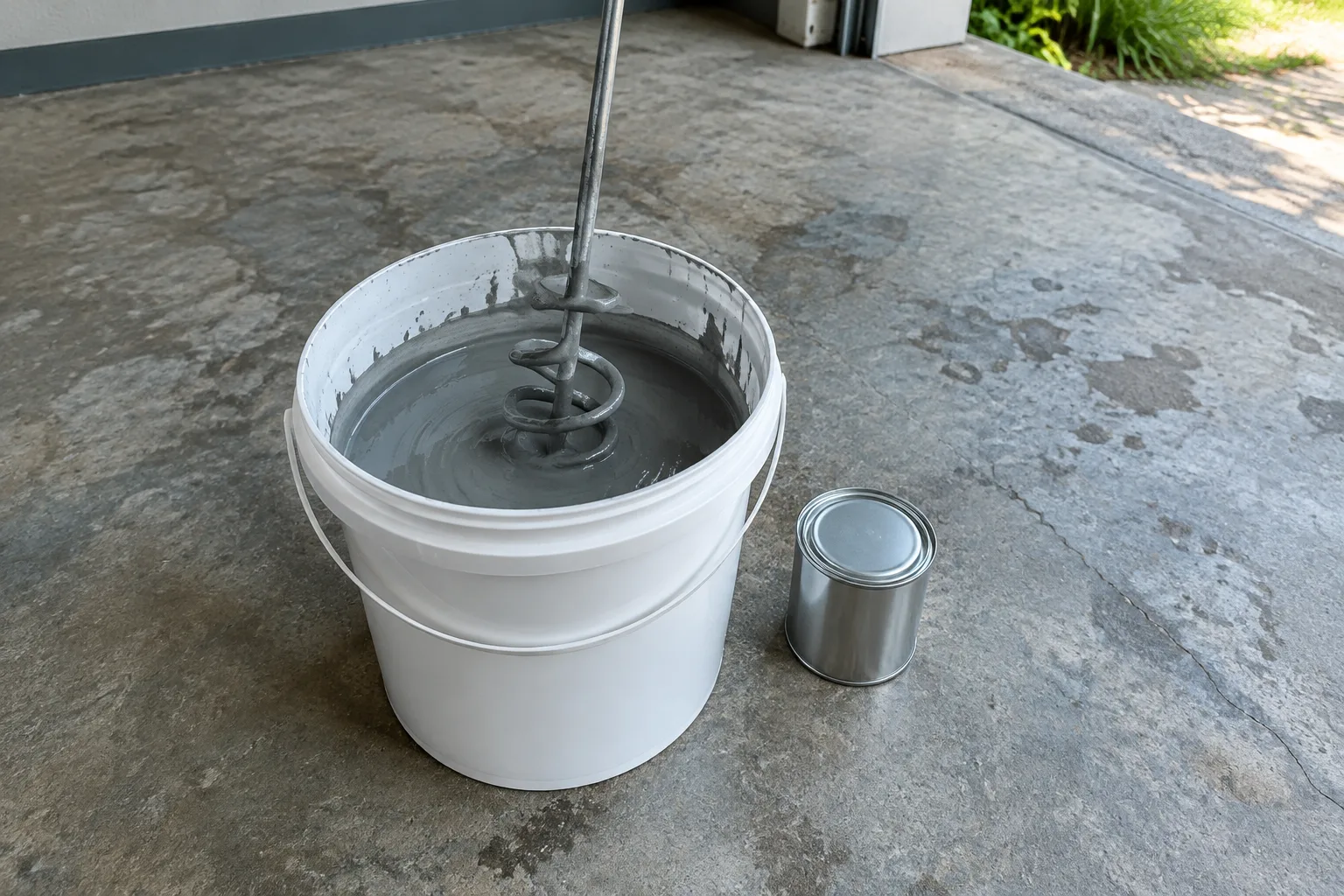
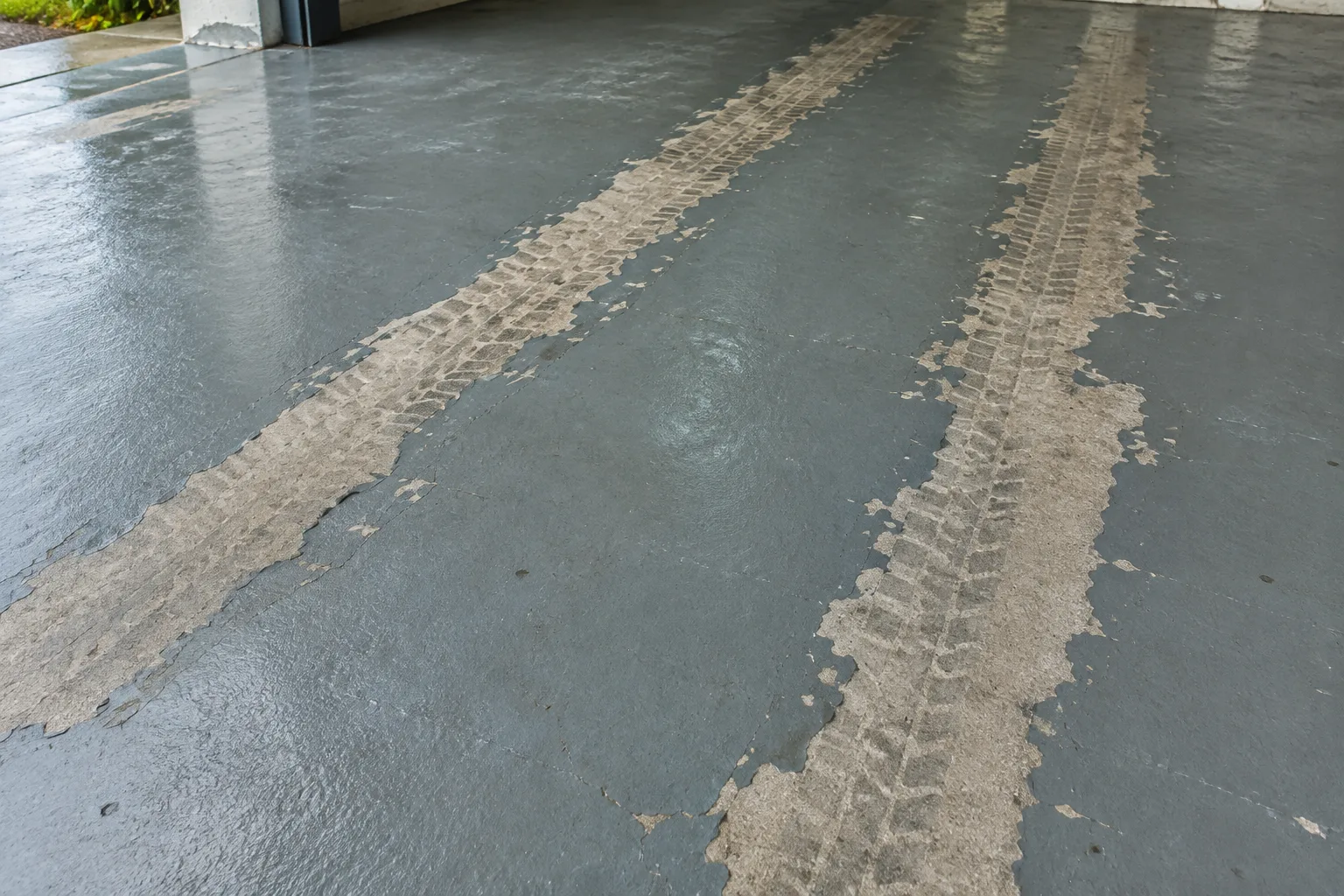
The Floorshield sheet is frank about where its paint does not belong. It lists car showrooms, heavy industrial use and "garage floors that are in prolonged contact with wet vehicle tyres". With Durban's summer rain, that warning reaches any garage that takes a wet car.
Rainy days each month at Durban airport
- 15Jan
- 13Feb
- 13Mar
- 9Apr
- 7May
- 5Jun
- 5Jul
- 7Aug
- 11Sep
- 15Oct
- 16Nov
- 15Dec
eThekwini Municipality, Energy Efficiency Guideline, Table 3: 130 rainy days a year, and about 60% of the year's rain falls from November to March.
Heat adds a second load. Resin makers sell resistance to hot-tyre pick-up as a feature: one resin supplier describes it as what keeps a coating from peeling or lifting when hot tyres touch it. A car parked straight off a summer drive brings both heat and water onto the same few square metres of floor every day.
The two-part products are sold for that job. Sika South Africa lists garages with light to medium traffic and car park decks among the uses for Sikafloor Garage. For a family garage that gets the full treatment, our epoxy garage floors in Durban start from a ground and tested slab, which is the part paint skips.
Damp slabs: where neither product is safe
Neither data sheet makes room for water rising through the slab, and both say so in plain words.
What each sheet says about a damp slab
Floor paint (Floorshield)
- Rules out substrates that have not fully dried out
- Rules out slabs without an effective damp-proof membrane
- Warns that some concrete floors take up to 12 months to dry in depth
Two-part epoxy (Sikafloor-264 ZA)
- No more than 4% moisture by weight in the slab
- No rising moisture under a polyethylene sheet test (the ASTM method its sheet refers to)
- A higher reading means a temporary moisture barrier goes down first
So the honest difference is procedure. Anyone with a free weekend can roll out a tin of paint. A proper epoxy job starts with a meter and a sheet test, and if the slab fails, the job changes before any resin is opened. The same applies on the humid day itself, which we cover in our piece on dew point and timing in Durban's humidity.
Working out cost per year
A price per square metre compares two things that last different lengths of time. A fairer sum is the full cost of each job divided by the years until you have to redo it.
| What goes into the sum | The paint job | The epoxy job |
|---|---|---|
| When the money goes | Small on day one, then again each time it wears through | Up front |
| Preparation the sheet asks for | A sound, clean, dry surface | Slab blasted or scarified to remove the weak cement skin, and repairs filled |
| Coats | Two full coats | Primer, then the coating, applied by experienced professionals |
| The cost people forget | Your weekends, every time it is redone | Removing any paint already on the slab |
For the epoxy side of that sum in rands, our Durban floor coating price guide lists what moves the number: slab condition, size and the system you choose.
When paint is the honest answer
There are floors where a single-pack paint does the job and epoxy would be money spent for nothing. The Floorshield sheet aims its paint at light to medium traffic, light industrial and domestic use, and repeated washing.
Paint or something tougher?
- A dry storeroom
- A laundry with no damp problem
- A spare room you want to tidy before selling
- Floors that stay wet, or a garage that takes a wet car most of the summer
- Spills of solvents, cutting oils or food, and heavy industry: the sheet's own words are specialist coatings
A workshop in Pinetown or a packing floor near the harbour belongs on our industrial and commercial resin floors page. A stoep or patio that takes direct sun is a separate question: the Sikafloor-264 ZA data sheet warns of some discolouration under sunlight, so outside we pick a system its maker rates for outdoor use and seal it with a UV-stable polyurethane topcoat. Our home floors page deals with covered patios and pool edges in more detail.
What we check before recommending either
On a site visit we measure slab moisture, tape down the plastic sheet for rising damp, and note the air temperature, humidity and slab temperature. If paint is enough, we say so. If the garage takes a wet car most of the summer, we price the two-part system with the preparation it needs. In an older house, whether in Durban North or further inland, the moisture reading comes before any talk of colour when nobody can say whether a membrane went in under the slab.
Send a photo and the size of the floor through the free quote form and we will tell you which of the two it needs.