

At 80% relative humidity, the most a South African epoxy data sheet allows, a slab can only be a fraction of a degree cooler than the air around it before it is too close to its dew point. That margin is what calls off coating work on a muggy Durban morning. A garage floor that has spent the night cooling can still be colder than the air after sunrise, and a thermometer on the wall will never show it.
What to take from this
- Three readings decide a coating day: air humidity (80% at most), slab temperature (10 to 30 °C) and the gap between the slab and the dew point (3 °C or more).
- At 70% humidity the slab can run roughly 3 °C below air temperature. At 80% the allowance drops under 1 °C, and at 85% the slab would have to be warmer than the air.
- Heat shortens the pot life to about 15 minutes at 30 °C and closes the recoat window after about a day.
- Durban airport's driest afternoons and fewest rainy days fall in June, July and August.
The readings a data sheet asks for
Every epoxy we would put down in Durban comes with a product data sheet, and the climate limits on it are specific. Sika South Africa's sheet for Sikafloor-264 ZA, a common two-part floor resin, sets the four below. It also warns that cold, damp conditions raise the chance of blooming on the finish.
The limits on the Sikafloor-264 ZA sheet
Sika South Africa, Sikafloor-264 ZA product data sheet, September 2026.
Cool air far enough and the water vapour in it turns to liquid; dew point names that temperature. If the concrete is at or near it, a film of water forms between the slab and the resin. The US edition of the same product's sheet spells out the trap: the slab may be cooler than the air. Its advice is to record the readings at least every three hours, and more often whenever conditions change.
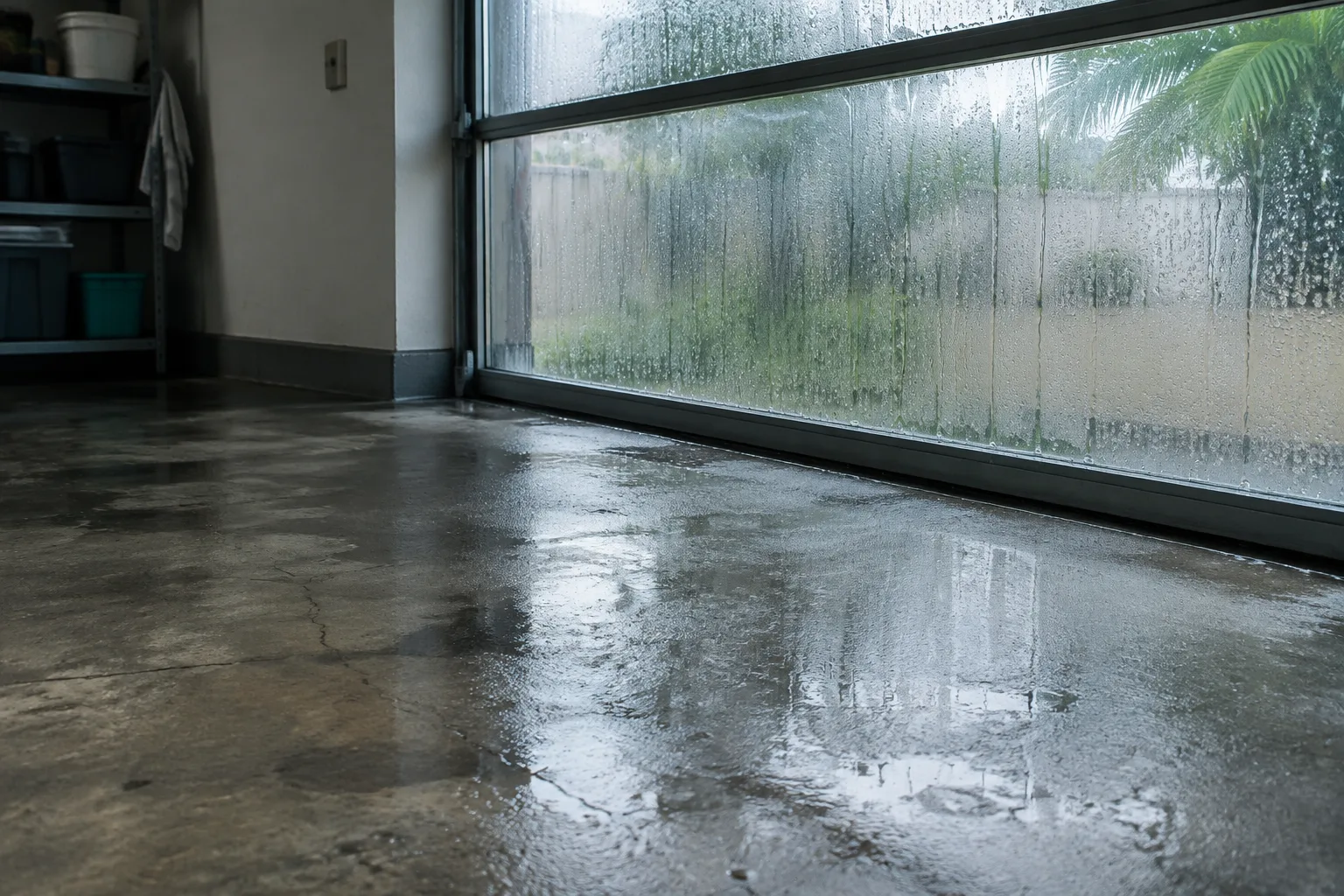
Water running down a garage window is the visible version of the problem. The glass has dropped below the dew point of the air inside. A slab doing the same thing shows nothing until the coating on top of it fails.
How much colder than the air can the slab be?
We worked the dew point out with the Magnus formula, using the coefficients published by Alduchov and Eskridge in 1996, for air temperatures and humidity levels you would see on a coastal day. The second figure in each cell adds the 3 °C margin, so it is the coldest the slab can be.
| Air temperature | 60% humidity | 70% humidity | 80% humidity | 85% humidity |
|---|---|---|---|---|
| 18 °C | 10.1 / 13.1 °C | 12.4 / 15.4 °C | 14.5 / 17.5 °C | 15.4 / 18.4 °C |
| 22 °C | 13.9 / 16.9 °C | 16.3 / 19.3 °C | 18.4 / 21.4 °C | 19.4 / 22.4 °C |
| 26 °C | 17.6 / 20.6 °C | 20.1 / 23.1 °C | 22.3 / 25.3 °C | 23.3 / 26.3 °C |
| 30 °C | 21.4 / 24.4 °C | 23.9 / 26.9 °C | 26.2 / 29.2 °C | 27.2 / 30.2 °C |
Each cell: dew point / lowest allowable slab temperature. Our calculation; 85% is shown for comparison only, since it is above the data sheet's 80% ceiling.
Read across any row and the margin collapses as humidity climbs. The 22 °C row, pulled out below, shows it best. That is why we put an infrared thermometer on the concrete itself rather than trusting the weather app.
Air at 22 °C: how much colder the slab may be
From the table above: air temperature minus the lowest allowable slab temperature.
What blush looks like, and why a second coat won't hide it
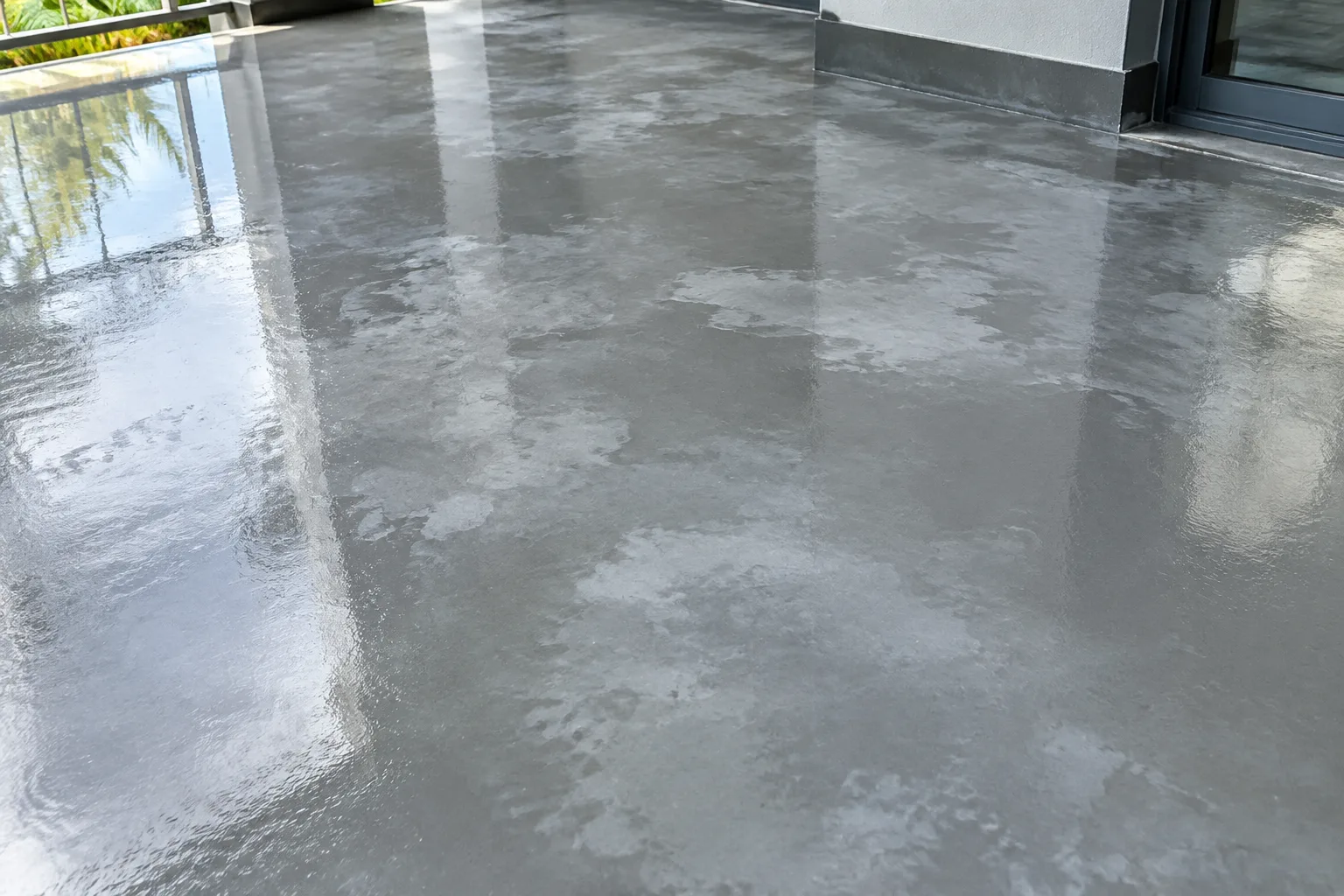
Amine blush is the usual way humidity shows itself on a finished epoxy floor. KTA-Tator, a coatings inspection firm, describes it as a reaction between water, carbon dioxide and the amine hardener in the epoxy, and says it typically appears as an oily or waxy film. Both high humidity and low temperature make it more likely, because a slow reaction leaves the hardener exposed for longer.
The damage goes past looks. The same article lists yellowing, lower gloss retention, a softer surface and weaker chemical resistance, and warns that blush left between coats can act as a bond breaker. Rolling a fresh coat over a cloudy one traps the problem.
Heat: less time in the bucket, a shorter recoat window
Durban's summer heat speeds every stage of the job. These are the times on the Sikafloor-264 ZA sheet.
| Temperature | Pot life once mixed | Next coat: earliest / latest | Walk on it | Light traffic | Full cure |
|---|---|---|---|---|---|
| 10 °C | about 50 min | 30 hours / 3 days | about 72 hours | about 6 days | about 10 days |
| 20 °C | about 25 min | 24 hours / 2 days | about 24 hours | about 4 days | about 7 days |
| 30 °C | about 15 min | 16 hours / 1 day | about 18 hours | about 2 days | about 5 days |
Fifteen minutes in the bucket on a hot day means mixing smaller batches and having the next one ready. The sheet also gives a latest time for the next coat, one day at 30 °C, so a multi-coat floor has to be planned around the following day's weather as well. Decorative finishes with several layers, like our metallic resin floors in Durban, need that planning more than a single-colour coat does.
Rising heat or falling heat: choosing the hour
Two Sika sheets give advice that pulls in opposite directions.
Which way should the temperature be moving?
Sikafloor-264 (US sheet)
- Not while the air and slab are warming
- Reason given: pinholes may form
Sikafloor-66 (Sika South Africa)
- A polyurethane: for outdoor work, apply on a falling temperature
- Rising temperatures can cause pin holing
The catch on a humid evening
- A falling temperature drags the slab toward its dew point
- The 3 °C margin can disappear before the coat has set
In practice we start once the slab has stopped warming, check the margin before mixing, and keep checking through the pour. For its first 24 hours the new coat has to stay dry, with no condensation settling on it and no water tracked or blown in, so a summer storm forecast for that night moves the job, even when the afternoon reading is fine.
The months with the most room
eThekwini Municipality publishes the mean 14h00 relative humidity and the rainy days per month measured at Durban airport. Mid-afternoon is only one moment in the day, but the pattern is clear.
| Months | Humidity at 14h00 | Rainy days per month |
|---|---|---|
| June, July, August | 54-60% | 5-7 |
| April, May, September | 61-66% | 7-11 |
| October to March | 68-71% | 13-16 |
Winter wins on both counts. The municipality's climate notes add that calm winter spells bring light north-north-westerly winds with low humidity in the early morning, turning north-easterly by midday. The trade-off is the cold end of the scale: a garage slab on a July morning has to be at 10 °C or above before resin goes down, so it gets measured, never assumed.
The same notes say conditions change the further you go from the coast, so a slab in Hillcrest is not read off the airport's numbers. Close to the sea, in Umhlanga apartments and homes, we take readings in the room being coated, since a closed garage and an open patio a few metres apart can give different answers.
Moisture from below, not just the air
Humid air is the visible half of the story. The slab carries its own water, and the Sikafloor-264 ZA sheet allows no more than 4% by weight, with no rising moisture under a polyethylene-sheet test. We test both before quoting a garage floor coating, because a damp slab fails on the driest day of the year. If you are still choosing between a paint and a resin system, our comparison of floor paint and two-part epoxy covers what each data sheet allows.
Our readings on the day, before any resin is mixed
- Air humidity in the room: 80% or lower
- Slab temperature: between 10 and 30 °C
- Slab at least 3 °C above the dew point, checked again while the temperature is moving
- Slab moisture 4% or less, and no water under a taped-down plastic sheet
- No gas, oil or paraffin heaters in the room
When you ask us for a quote, tell us whether the floor is indoors or out and which way it faces. We bring the meters on the visit and plan the coating day around the readings.